Japanese Wedding Traditions: The Shinto Ceremony Explained (2026 Guide)
What Is a Traditional Japanese Wedding Ceremony?
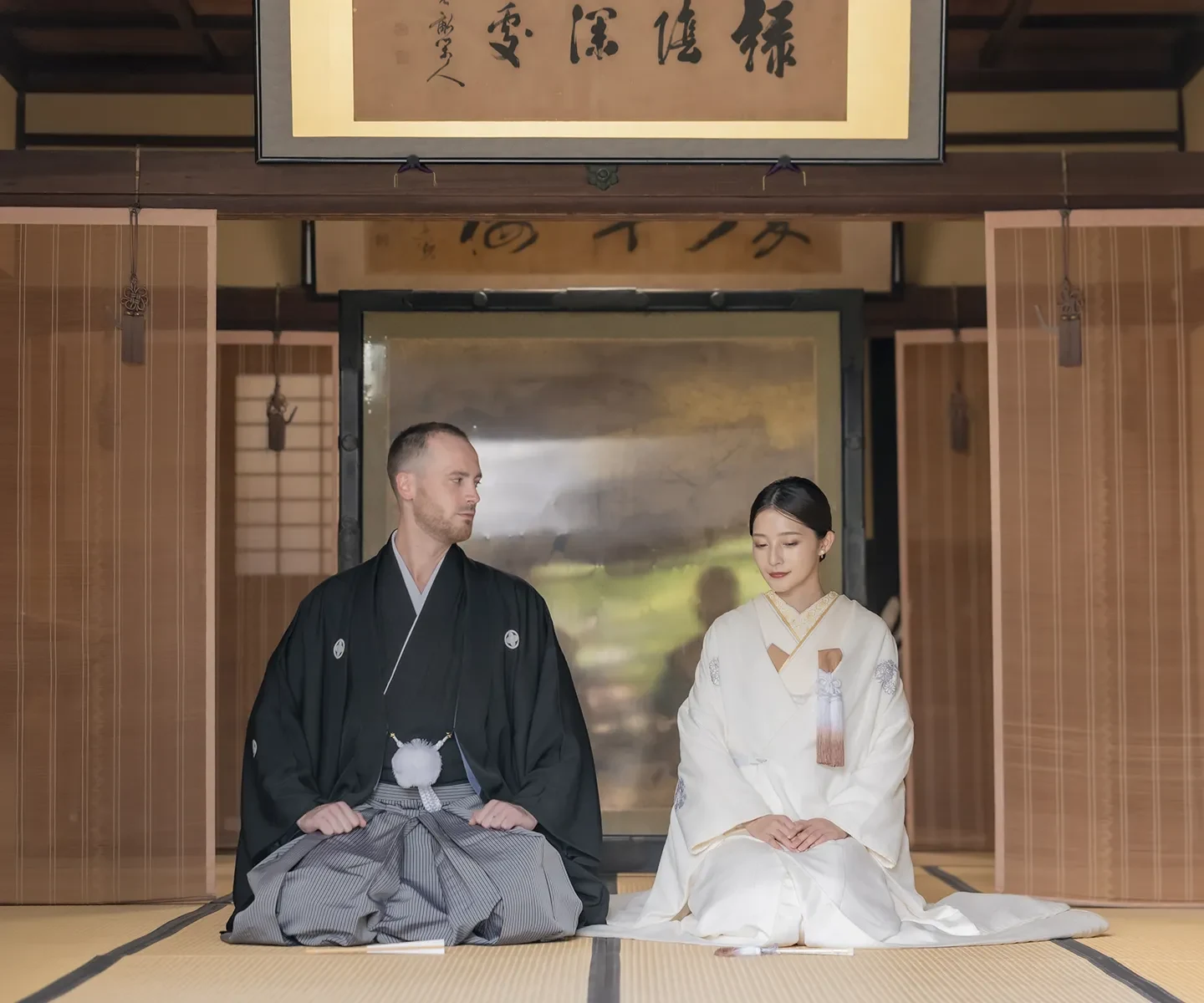
A traditional Japanese wedding is a Shinto ceremony, known as shinzen-shiki (神前式), which means “a ceremony held before the gods.” It takes place at a Shinto shrine, or in a dedicated shrine room, and is led by a Shinto priest.
Shinto is the indigenous spiritual tradition of Japan. It centres on respect for nature, ancestors, and the kami, the sacred spirits believed to live in mountains, rivers, trees, and shrines. A Shinto wedding is, at its heart, the couple reporting their marriage to the kami and asking for their blessing on a long life together.
The ceremony is quiet, formal, and deeply atmospheric. There is no exchange of long personal vows in front of a big crowd, and no officiant asking “do you take this person.” Instead there is ritual: purification, prayer, the sharing of sacred sake, and an offering to the gods. For couples who want their wedding to feel rooted in something older and larger than themselves, it is unlike anything a Western ceremony offers.
Where Did the Shinto Wedding Ceremony Come From?
The Shinto shrine wedding as we know it today is younger than most people assume. For most of Japanese history, weddings were held at home, in front of the family altar, not at a shrine.
The modern shrine ceremony traces directly to a royal wedding. In 1900, the wedding of Crown Prince Yoshihito, who later became Emperor Taishō, was conducted in Shinto form inside the Imperial Palace. The ceremony captured the public imagination, and the following year, in 1901, a Tokyo shrine now known as Tokyo Daijingū adapted those imperial rites into a ceremony ordinary couples could have. That is the origin of the public shrine wedding.
So when you marry at a Japanese shrine, you are taking part in a tradition shaped by an imperial wedding at the turn of the twentieth century, built on far older customs of sharing sake and reporting a marriage to the gods.
What Actually Happens During a Shinto Wedding Ceremony?
A Shinto wedding follows a set order of rituals, guided at every step by the priest and shrine attendants. You are never left guessing what to do. The whole ceremony takes about 20 to 30 minutes.
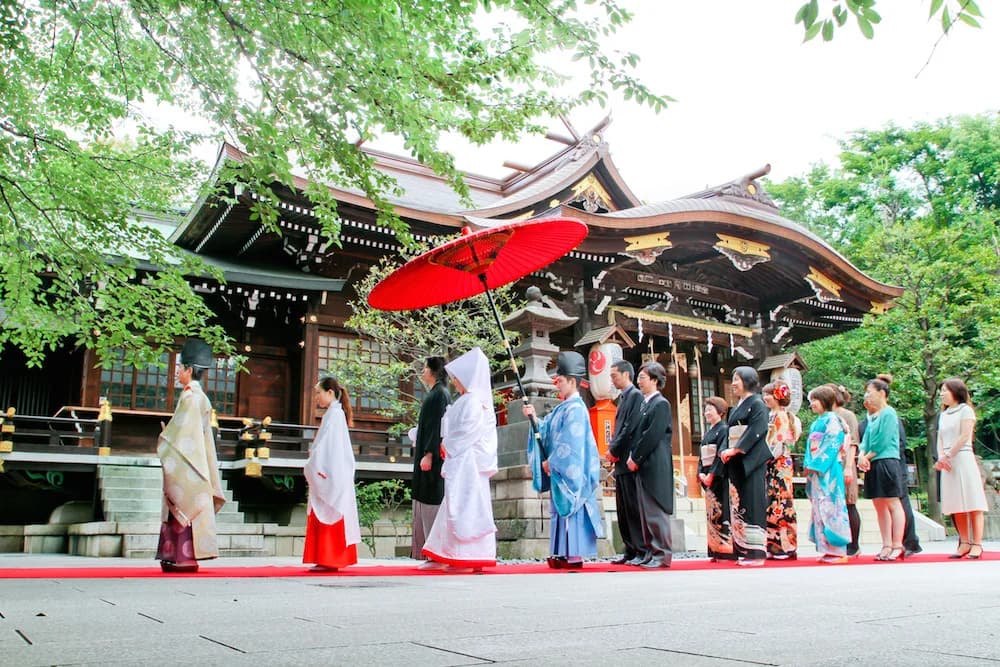
The exact details vary from shrine to shrine, but the ceremony published by the Association of Shinto Shrines (Jinja Honchō) gives the standard sequence. Many shrines begin with a procession (sanshin-no-gi), in which the couple, led by a priest and a shrine maiden under a red parasol, walk to the ceremony hall. This is the image most people picture when they imagine a Japanese wedding.
Inside, the ceremony unfolds like this:
| Ritual | Japanese name | What happens |
|---|---|---|
| Purification | Shubatsu (修祓) | The priest performs a rite to purify the couple and guests before the gods. |
| Prayer | Norito sōjō (祝詞奏上) | The priest announces the marriage to the kami and prays for the couple's lasting happiness. |
| Sharing of sake | San-san-kudo (三々九度) | The couple drink sacred sake from three cups in a set pattern. The heart of the ceremony. |
| Vows | Seishi sōjō (誓詞奏上) | The couple read a pledge of marriage aloud before the gods. |
| Offering | Tamagushi hōten (玉串奉奠) | The couple offer a small sacred branch at the altar, with two bows, two claps, and a bow. |
| Family sake | Shinzoku sakazuki-no-gi (親族盃の儀) | Both families drink sake together, symbolising the joining of two households. |
Some shrines also include a ring exchange or a shrine-maiden dance (kagura). The ring exchange is a more recent addition, brought in under Western influence, and is not part of the original Shinto tradition, but it is common today and easy to include.
What Is San-San-Kudo?
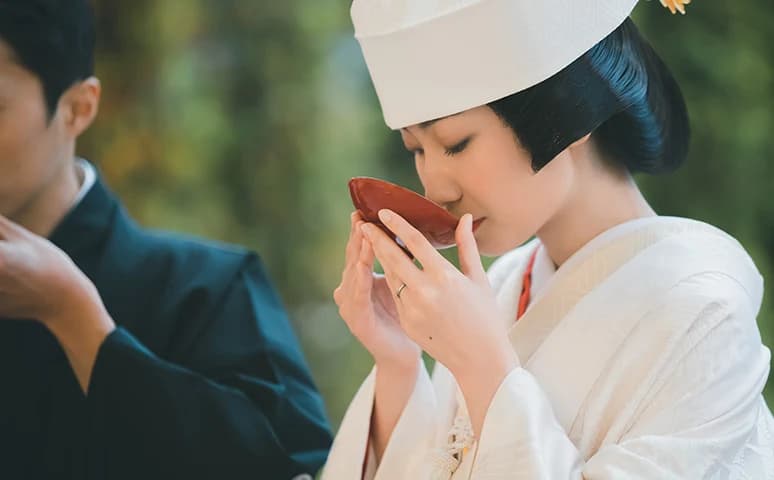
San-san-kudo (三々九度) is the sake-sharing ritual at the centre of a Shinto wedding, and for many couples it is the most moving part of the day. The name means “three, three, nine.”
Here is how it works. There are three stacked lacquer cups, small, medium, and large. The couple take turns sipping sake from each cup, three sips per cup, for nine sips in total. That is where “three-three-nine” comes from.
The symbolism runs deep. In Japanese tradition, odd numbers are auspicious, and nine is the highest single-digit odd number, so the ritual is a wish for the greatest possible fortune. The three cups are understood in different ways depending on who you ask: some say they represent heaven, earth, and humanity; others say past, present, and future; others say the couple and the union of their two families. All of these readings point to the same idea, two people and two families bound together for the long road ahead.
What Do the Bride and Groom Wear?
Traditional Japanese wedding attire is among the most striking bridal clothing in the world.
The bride traditionally wears a shiromuku (白無垢), a full ensemble in pure white, from the kimono to the overcoat. White symbolises purity and a fresh beginning. Over her hair she may wear one of two traditional coverings: the wataboshi (綿帽子), a soft white hood worn only with the white shiromuku, or the tsunokakushi (角隠し), a white band worn over a traditional hairstyle. Many brides also change into a brightly coloured overcoat called an iro-uchikake (色打掛), often deep red and gold, either for the ceremony or afterwards.
The groom wears a montsuki-hakama (紋付羽織袴), a formal black kimono marked with his family crest, worn with a haori jacket and wide pleated hakama trousers. It is understated, dignified, and a perfect counterpoint to the bride's kimono.
| Garment | Worn by | Meaning |
|---|---|---|
| Shiromuku (白無垢) | Bride | Pure white kimono ensemble. Purity and a fresh start. |
| Iro-uchikake (色打掛) | Bride | Colourful brocade overcoat. Celebration and good fortune. |
| Wataboshi (綿帽子) | Bride | White hood worn with shiromuku. Modesty and grace. |
| Tsunokakushi (角隠し) | Bride | White band over the hair. Worn with white or coloured kimono. |
| Montsuki-hakama (紋付羽織袴) | Groom | Black crested formal kimono. The most formal male attire. |
Who Attends a Traditional Japanese Wedding?
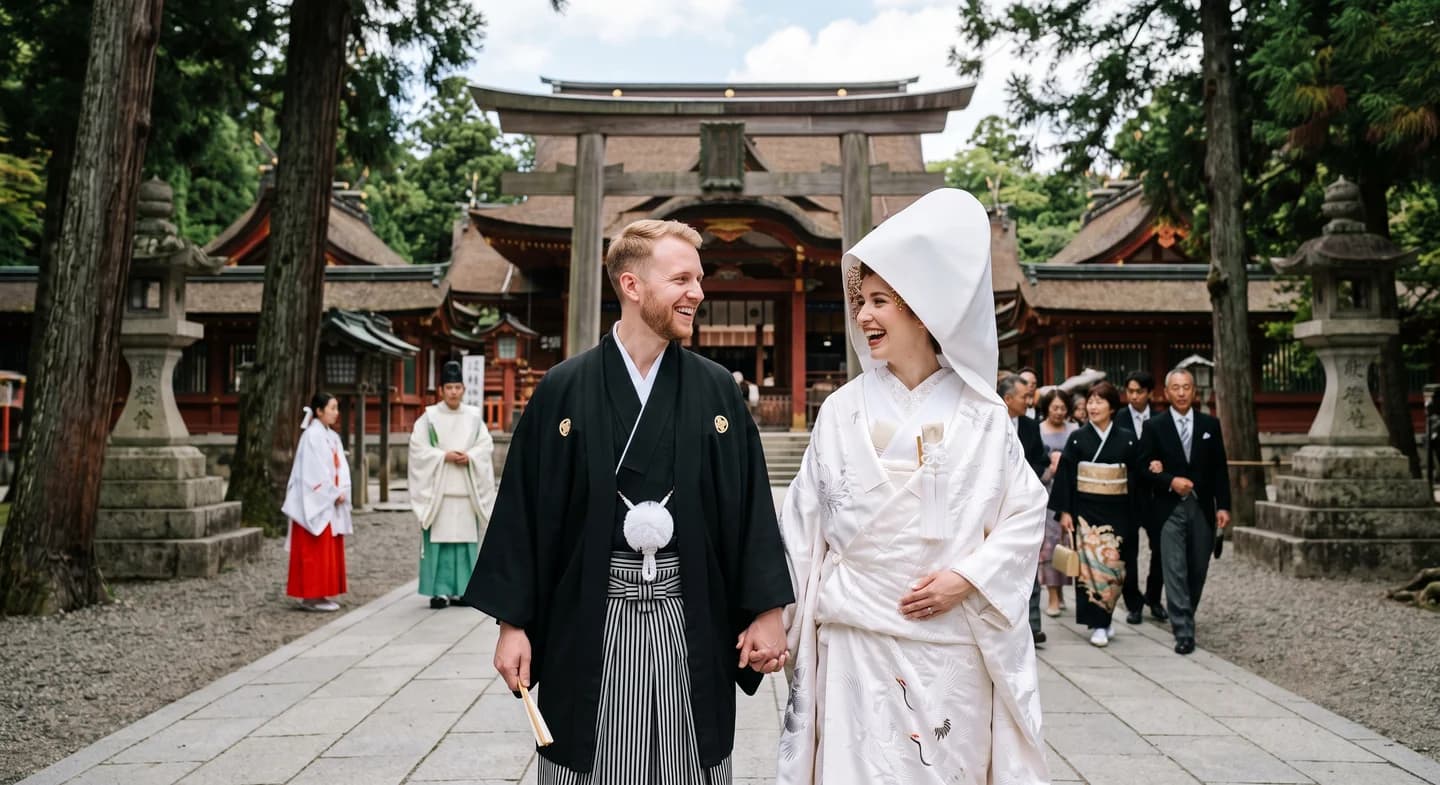
Shinto ceremonies are traditionally intimate. Historically only the couple's immediate family and closest relations attended, and many shrine ceremony halls still seat only a small number of guests. This is part of the appeal for a lot of international couples: the ceremony feels personal and unhurried rather than performed for a large audience.
In the past, a married go-between couple called a nakōdo (仲人) played a central role, helping to arrange the match and vouching for both families. Today the nakōdo is largely ceremonial or left out altogether. There is also no equivalent of a Western bridal party, no bridesmaids or groomsmen. The focus is on the two families coming together rather than on a wedding party.
What Happens After the Ceremony?
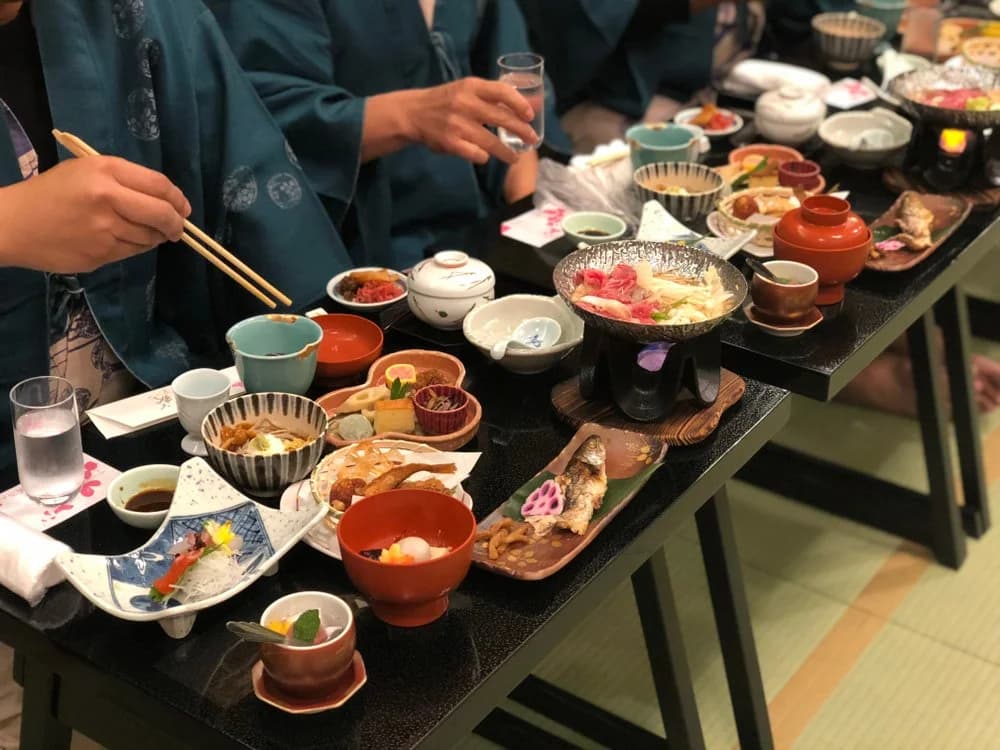
After the ceremony comes the celebration. Traditionally this is a reception (hirōen, 披露宴), often a multi-course kaiseki meal at a historic Japanese restaurant, where the couple, family, and guests eat, drink, and mark the occasion together.
Two customs stand out. First, the bride often performs an outfit change (oironaoshi, お色直し), stepping out of her white shiromuku and returning in a colourful kimono or a Western gown, a moment guests always look forward to. Second, Japanese weddings have a strong gift-giving culture: guests bring congratulatory gift money in special envelopes, and the couple send everyone home with carefully chosen return gifts. There is no tipping in Japan, so this exchange of gifts is how gratitude is expressed.
For couples marrying with just the two of them or a small group, this part scales down beautifully, from a grand banquet to an intimate private lunch at a centuries-old restaurant near the shrine.
What Are the Other Types of Wedding Ceremony in Japan?
Not every wedding in Japan is a Shinto shrine wedding. There are four main ceremony styles, and it helps to know the difference.
| Ceremony type | Japanese name | What it is |
|---|---|---|
| Shinto | Shinzen-shiki (神前式) | A traditional ceremony at a shrine, led by a priest, before the gods. The focus of this guide. |
| Chapel / Christian-style | Kyōkai-shiki (教会式) | A Western-style ceremony before a cross, led by a minister. Chosen for its look; no faith required. |
| Civil / in front of guests | Jinzen-shiki (人前式) | A non-religious ceremony where the couple pledge before their guests, who act as witnesses. |
| Buddhist | Butsuzen-shiki (仏前式) | A rare ceremony held at a temple before the Buddha and the couple's ancestors. |
For international couples who want something unmistakably Japanese, the Shinto ceremony is the one that captures the country's history, setting, and ritual all at once.
Can Foreign Couples Have a Traditional Japanese Wedding?
Yes. This is the question we hear most, and the answer is a clear yes. You do not need to be Japanese, you do not need to be Shinto, and you do not need to be religious at all. Shinto has no doctrine to sign up to and no conversion, and couples are never asked about their beliefs. International couples are genuinely welcome at many shrines.
There are two things worth understanding early. The first is language: shrine ceremonies are conducted in Japanese, and the surrounding arrangements, kimono, hair and makeup, restaurant, transport, are all handled in Japanese. This is exactly where a bilingual planner earns their place, so that nothing is lost and you can simply be present on the day.
The second is the legal side, covered next.
Is a Shinto Shrine Wedding Legally Binding?
In practice, this is simple. Most international couples complete their legal marriage at home, in their own country, and travel to Japan for the ceremony itself, treating the shrine wedding as the real, meaningful celebration of their union. Couples who do want to be legally married in Japan can be, but it involves embassy paperwork and municipal filings that are worth handling with guidance.
Requirements differ by nationality and change from time to time, so always confirm the current process with your embassy and the relevant Japanese municipal office before you travel. Our guide to getting married in Japan as a foreigner walks through the paperwork route in detail.
Planning a Traditional Japanese Wedding
A Shinto wedding is one of the most beautiful ways to marry, and also one of the most culturally specific. Shrines have their own rules, their own booking windows, and their own way of doing things, almost all of it in Japanese. That is what we do.
Married in Japan is a bilingual wedding planning company based in Tokyo. Juri is Japanese and manages everything on the ground, from the shrine and the kimono to the restaurant and the day itself, while we guide you through the whole process in English. If you have ever pictured marrying in a kimono at a centuries-old Japanese shrine, we can make it real. Have a look at what we plan for couples eloping in Japan, shrine ceremony included.
Frequently Asked Questions
What is a Shinto wedding called in Japanese?
A Shinto wedding is called shinzen-shiki (神前式), which means “a ceremony before the gods.” It is held at a Shinto shrine and led by a priest.
How long does a Shinto wedding ceremony last?
The ceremony itself lasts around 20 to 30 minutes. Preparation on the day, including kimono dressing and hair and makeup, takes a few hours beforehand.
What is san-san-kudo?
San-san-kudo is a ritual in which the couple share sacred sake from three cups, three sips from each, for nine sips in total. It symbolises the couple and their families being bound together, and it is the emotional centre of the ceremony.
What does the bride wear at a Japanese wedding?
The bride traditionally wears a shiromuku, a pure white kimono ensemble, often with a white hood called a wataboshi. Many brides also change into a colourful iro-uchikake overcoat for or after the ceremony.
What does the groom wear at a Japanese wedding?
The groom wears a montsuki-hakama, a formal black kimono bearing his family crest, with a haori jacket and pleated hakama trousers.
Can foreigners get married at a Japanese shrine?
Yes. You do not need to be Japanese, Shinto, or religious. Many shrines welcome international couples, though the ceremony is conducted in Japanese, so a bilingual planner is a great help.
Is a shrine wedding a legal marriage?
No. A Shinto shrine ceremony is symbolic. Legal marriage in Japan requires filing a marriage registration (konin todoke) at a municipal office. Most international couples marry legally at home and hold the shrine ceremony as their celebration.
What is the best time of year for a Japanese wedding?
Spring (cherry blossom season, late March to April) and autumn (foliage, October to November) are the most popular, for their weather and scenery. Both book out early.
Official Sources and References
- Association of Shinto Shrines (Jinja Honchō) — official guide to the Shinto wedding ceremony
- Tokyo Daijingū — on the origins of the public shrine wedding
- U.S. Embassy Tokyo — marriage and notarial requirements for foreign nationals
- Individual shrine official websites, for ceremony details and availability